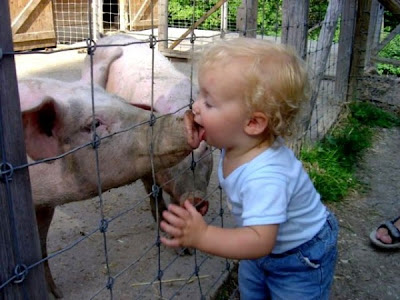
"Ela é transmitida dos porquinhos para as pessoas só quando eles espirram. Portanto, a providência elementar é não ficar perto de porquinho nenhum" (José Serra, sobre a gripe suína).
Este post pertence à Roda de Ciência. Por favor, deixe seus comentários lá.

This article reviews quantitative methods to estimate the basic reproduction number of pandemic influenza, a key threshold quantity to help determine the intensity of interventions required to control the disease. Although it is difficult to assess the transmission potential of a probable future pandemic, historical epidemiologic data is readily available from previous pandemics, and as a reference quantity for future pandemic planning, mathematical and statistical analyses of historical data are crucial. In particular, because many historical records tend to document only the temporal distribution of cases or deaths (i.e. epidemic curve), our review focuses on methods to maximize the utility of time-evolution data and to clarify the detailed mechanisms of the spread of influenza. First, we highlight structured epidemic models and their parameter estimation method which can quantify the detailed disease dynamics including those we cannot observe directly. Duration-structured epidemic systems are subsequently presented, offering firm understanding of the definition of the basic and effective reproduction numbers. When the initial growth phase of an epidemic is investigated, the distribution of the generation time is key statistical information to appropriately estimate the transmission potential using the intrinsic growth rate. Applications of stochastic processes are also highlighted to estimate the transmission potential using the similar data. Critically important characteristics of influenza data are subsequently summarized, followed by our conclusions to suggest potential future methodological improvements.
| Comments: | 79 pages (revised version), 3 figures; added 1 table and minor revisions were made in the main text; to appear in Physics of Life Reviews; Gerardo's website (this http URL), Hiroshi's website (this http URL) | ||||||||||
| Subjects: | Populations and Evolution (q-bio.PE) | ||||||||||
| Cite as: | arXiv:0711.3088v2 [q-bio.PE]Modeling the Worldwide Spread of Pandemic Influenza: Baseline Case and Containment Interventions(Submitted on 24 Jan 2007) We present a study of the worldwide spread of a pandemic influenza and its possible containment at a global level taking into account all available information on air travel. We studied a metapopulation stochastic epidemic model on a global scale that considers airline travel flow data among urban areas. We provided a temporal and spatial evolution of the pandemic with a sensitivity analysis of different levels of infectiousness of the virus and initial outbreak conditions (both geographical and seasonal). For each spreading scenario we provided the timeline and the geographical impact of the pandemic in 3,100 urban areas, located in 220 different countries. We compared the baseline cases with different containment strategies, including travel restrictions and the therapeutic use of antiviral (AV) drugs. We show that the inclusion of air transportation is crucial in the assessment of the occurrence probability of global outbreaks. The large-scale therapeutic usage of AV drugs in all hit countries would be able to mitigate a pandemic effect with a reproductive rate as high as 1.9 during the first year; with AV supply use sufficient to treat approximately 2% to 6% of the population, in conjunction with efficient case detection and timely drug distribution. For highly contagious viruses (i.e., a reproductive rate as high as 2.3), even the unrealistic use of supplies corresponding to the treatment of approximately 20% of the population leaves 30%-50% of the population infected. In the case of limited AV supplies and pandemics with a reproductive rate as high as 1.9, we demonstrate that the more cooperative the strategy, the more effective are the containment results in all regions of the world, including those countries that made part of their resources available for global use.
|
Viral kinetics have been extensively studied in the past through the use of spatially homogeneous ordinary differential equations describing the time evolution of the diseased state. However, spatial characteristics such as localized populations of dead cells might adversely affect the spread of infection, similar to the manner in which a counter-fire can stop a forest fire from spreading. In order to investigate the influence of spatial heterogeneities on viral spread, a simple 2-D cellular automaton (CA) model of a viral infection has been developed. In this initial phase of the investigation, the CA model is validated against clinical immunological data for uncomplicated influenza A infections. Our results will be shown and discussed.
| Comments: | LaTeX, 12 pages, 18 EPS figures, uses document class ReTeX4, and packages amsmath and SIunits |
| Subjects: | Cell Behavior (q-bio.CB); Quantitative Methods (q-bio.QM) |
| Journal reference: | Journal of Theoretical Biology, 232(2), 21 January 2005, pp. 223-234 |
| DOI: | 10.1016/j.jtbi.2004.08.001 |
| Cite as: | arXiv:q-bio/0402012v1 [q-bio.CB] |


Enviado por João Carlos, do Chi Vó Non Pó.
Uma coisa curiosa: de todos os animais comestíveis, parece que apenas o porco tem um sabor similar ao dos seres humanos. Seria isso a origem dos tabus alimentares sobre o porco? Evitar a antropofagia?
E o genoma do porco? Já sequenciaram? Qual a porcentagem de superposição com o genoma humano?
E que tal a seguinte idéia para uma ética da culinária: os seres humanos deveriam progressivamente ir abandonando o consumo de animais ranqueados segundo uma lista de overlap genômico, ou seja, quem é mais parecido conosco geneticamente nós deixamos para comer por último... uma espécie de tabu do incesto culinário.
A vantagem óbvia desse critério é que ele é objetivo e traz um benefício genérico para a humanidade: quanto mais afastado geneticamente um animal, mais dificil ele nos transmitir ou servir de reservatório para mixing viral de alguma doença pandêmica.
Investigator Sally Shelton sends this observation that appeared on a paleontologists discussion listserv:
I’m often amazed that people on this list seem unaware of some of the classic literature… Culinary phylogenetics was addressed in an issue of AIR way back in 1998. You can find a pdf here.
The discussant refers to Joe Staton’s study “Tastes Like Chicken,” published in volume 4, number 4 of the Annals of Improbable Research, and which begins with the statement
The field of culinary evolution faces one great dilemma: why do most cooked, exotic meats taste like cooked Gallus gallus, the domestic chicken?
A chart from the study is reproduced below.


It's the Spock plot strands that give the new "Trek" its best shot at once again commanding the zeitgeist. Spock's cool, analytical nature feels more fascinating and topical than ever now that we've put a sort of Vulcan in the White House. All through the election campaign, columnists comparedPresident Obama's unflappably logical demeanor and prominent ears with Mr. Spock's. But as Spock's complicated racial backstory is spun out in detail in the new "Trek"—right back into childhood—the Obama parallels keep deepening. Like Obama, Spock is the product of a mixed marriage (actually, an interstellar mixed marriage), and he suffers blunt manifestations of prejudice as a result. As played by Zachary Quinto, the young Spock loves his human mother, but longs to assimilate completely into his Vulcan father Sarek's ways, eschewing messy emotions the way all Vulcans do. Young Spock is constantly being told by Vulcans and humans alike that he's either seething with inappropriate emotions—indeed, he takes Kirk by the throat at one point—or that he's not emotional enough and shouldn't be so repressed. Obama may or may not be a fan—the White House says he isn't, but Trekkies have claimed him as one of their breed ever since he said, "I grew up on 'Star Trek'—I believe in the final frontier," at a campaign stop last year. If he does check out the new movie, I can imagine he might feel a special empathy for Spock's position, given the chattering class's insistence that he needs to show more emotion, too.
There's one more intriguing allegorical overtone to the new "Trek," perhaps completely accidental. With the willfully hegemonic Bush administration now gone, the tenets of Roddenberry's fictional universe feel very much in step with current events. Whether you're happy about it or not, the Obama foreign policy, at least for now, emphasizes cross-cultural exchange and eschews imperialistic swagger. That sounds very much in sync with the Federation's Prime Directive, which stipulates that humanity should observe but never interfere with alien cultures (no Iraq-style invasions, in other words).
(...)


Deu na lista do CLFC no Orkut:
Sai mesmo em 2009 pela Aleph.
R$39,00 cada volume.
A trilogia podera' ser adquirida em tres livros separados, ou em um box
especial, contendo os tres volumes.
Capas:
-Fundação
Tradução de Fábio Fernandes (com Marcelo Barbão)
http://farm4.static.flickr.com/3576/3433144262_ff8f7b284f_o.jpg
-Fundação e Império
Tradução de Fábio Fernandes (com Marcelo Barbão)
http://farm4.static.flickr.com/3581/3433143988_0731aaf8b4_o.jpg
-Segunda Fundação
Tradução de Marcelo Barbão
http://farm4.static.flickr.com/3332/3432332597_5f789bddb5_o.jpg
Abs,
Eduardo Torres